

Bitcoin’s best and newest large buyer has no face, no investment committee, and no public opinion about whether the price looks cheap.
It appears near the end of the US trading day as an entry beside an ETF ticker, and on Aug. 27 that entry showed $277.6 million flowing into IBIT while the entire US spot Bitcoin fund category saw $242.3 million in inflows.
That means the other products combined lost $35.3 million, leaving BlackRock’s fund to carry the group through a difficult day.
The same pattern becomes much more interesting when you look across the market’s full history.
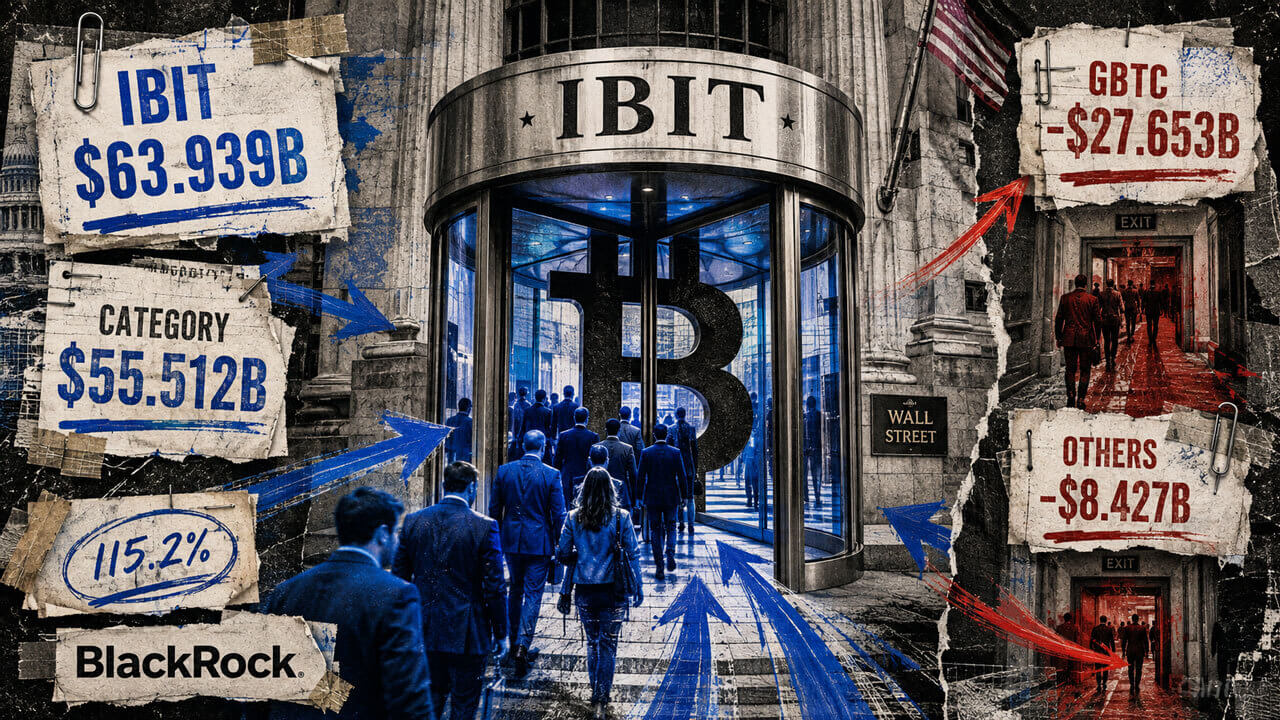
From the January 2024 launch through Sept. 3, 2026, IBIT collected over $63.9 billion in cumulative net inflows, according to Farside Investors’ fund ledger. The entire group, including IBIT, kept $55.5 billion, and subtracting one from the other leaves every fund outside IBIT with a combined $8.4 billion in net outflows.
That gives IBIT 115.2% of the category’s net inflow, a percentage that sounds impossible until you include the withdrawals elsewhere.
If one person puts $115 on a table while everybody else removes a combined $15, the table ends with $100. IBIT is the person adding money, and the category total is what stays on the table.
The ledger shows that IBIT brought in enough to cover those withdrawals at the category level.
That’s the case for treating one ETF as Bitcoin’s buyer of last resort. IBIT has supplied every dollar the US fund group retained, plus enough to offset the net exits from all of its rivals.
The comparison has a firm limit because a central bank serving as a buyer of last resort has a public mandate and can create money, while IBIT expands only when investors ask for more shares. Its backstop comes from the repeated behavior of a large crowd, with BlackRock providing the vehicle.
| US spot Bitcoin ETF flows through Sept. 3, 2026 | Net flow |
|---|---|
| BlackRock’s IBIT | $63.939 billion |
| Entire US spot Bitcoin ETF group | $55.512 billion |
| Every fund outside IBIT, combined | -$8.427 billion |
| Grayscale’s GBTC | -$27.653 billion |
| All funds except IBIT and GBTC | $19.226 billion |
Source: Farside Investors’ daily US spot Bitcoin ETF flow data. Figures are cumulative net creations and redemptions, not trading volume. The final row removes both IBIT and GBTC from the category total.
The ETF that swallowed everyone else’s exits
Most of the negative column belongs to Grayscale Bitcoin Trust, which entered the ETF era carrying a huge pool of Bitcoin and a 1.50% fee. Its conversion finally gave shareholders a redemption route, while cheaper products gave those who wanted to stay invested an obvious place to move.
The flow data can’t separate those migrations from outright Bitcoin sales, though it does show that GBTC has recorded $27.6 billion in net outflows since January 2024.
That history can make IBIT’s 115.2% share look like an accounting trick built entirely around one expensive legacy fund, so a more accurate calculation removes both IBIT and GBTC. The rest of the market took in $19.2 billion across the cheaper field led by Fidelity and several smaller issuers. IBIT still brought in more than three times their combined sum.
Its current scale helps explain the gap because as of Sept. 3, BlackRock reported about $63.44 billion in IBIT net assets, 1.375 billion shares outstanding, a 0.25% sponsor fee, and a 0.02% 30-day median bid-ask spread.
The portfolio contained one asset, Bitcoin, while the wrapper offered an experience investors already knew from stock and bond ETFs, complete with a familiar ticker, conventional account statements, deep daily trading, and exposure without managing private keys.
The concentration has continued well beyond the launch, with IBIT drawing $2.843 billion of the group’s $3.655 billion across the 14 trading sessions from Aug. 17 through Sept. 3, or 77.8%.
It frequently carried the category during positive sessions and offset redemptions elsewhere, continuing a pattern seen in July when one IBIT inflow revived an otherwise weak daily total.
The result tells us a lot about how new demand reaches Bitcoin. A dozen funds now offer separate entrances, but capital has clustered around the product with the biggest brand, deepest trading, and broadest access to conventional portfolios.
The network underneath can be distributed worldwide, while its main US financial entrance narrows to a single revolving door.
BlackRock is the ETF address
ETF activity happens in two related markets, and separating them makes the flow numbers much easier to understand.
During the trading day, investors buy and sell existing IBIT shares with one another on Nasdaq. Billions of dollars can trade in that secondary market while the number of shares and the trust’s Bitcoin holdings stay the same.
The underlying pool expands through the primary market, where authorized participants submit orders for large blocks of new shares under the procedures in the IBIT prospectus. The trust receives Bitcoin or cash through the permitted creation process, while redemptions run the same mechanism in reverse.
Arbitrage gives participating firms an incentive to create shares when IBIT trades above the value of the Bitcoin represented by each share and redeem when it trades below, which keeps the fund close to its net asset value.
Daily flow estimates try to measure that primary-market expansion and contraction. Trading volume shows how many shares moved between investors, while net creations show whether the trust grew.
| Market signal | What happens | Does Bitcoin exposure in the trust change? | Why it matters |
|---|---|---|---|
| Secondary-market trading | Investors buy and sell existing IBIT shares | No | Shows turnover, liquidity, and demand between shareholders |
| Primary-market creations | Authorized participants create new ETF shares | Yes, trust expands | Indicates fresh capital entering the vehicle |
| Primary-market redemptions | Shares are redeemed through the ETF mechanism | Yes, trust contracts | Indicates capital leaving the vehicle |
| Premium/discount to NAV | ETF trades above or below underlying Bitcoin value | Not directly | Shows whether arbitrage is keeping the wrapper aligned |
| Shares outstanding | Total ETF shares rise or fall | Yes, over time | Confirms whether IBIT is actually growing or shrinking |
On a volatile day, a huge burst of share trading can reflect disagreement among existing owners, while a net inflow means fresh capital entered the vehicle and enlarged its claim on Bitcoin.
BlackRock built and sponsors the product, maintains its institutional relationships, earns the fee, and provides the name printed across the top. The economic buyers are the people and organizations whose orders drive creation, which makes “BlackRock bought Bitcoin” a convenient shorthand for a distribution machine combining thousands of separate decisions.
That machine has structural advantages because financial advisers can place IBIT inside model portfolios, companies can hold it through familiar custody arrangements, and retirement investors can gain exposure without learning wallet security or exchange operations.
Heavy daily trading makes big orders easier to execute, which attracts more large orders, while BlackRock’s name lowers the amount of explaining an adviser must do before discussing an allocation.
The result is a unique split inside Bitcoin, where ownership of the network asset is still dispersed, and the protocol runs independently of BlackRock, while a large portion of fresh US investment passes through one sponsor, one trust, a concentrated custody chain, and a limited group of firms authorized to create or redeem shares.
Decentralization at the protocol layer can coexist with concentrated access at the capital-markets layer.
A backstop with a sell button
The same structure that makes IBIT feel dependable also defines its limits. It has no reserve fund waiting for a Bitcoin crash and no instruction to buy when the price falls.
BlackRock provides the vehicle while shareholders control the direction, so persistent inflows create the appearance of a backstop for as long as that crowd keeps adding money.
Sept. 1 showed the other side in one entry as IBIT lost $201.2 million, Fidelity’s fund lost $43.7 million, and the group posted a $236.5 million outflow. One session later, IBIT brought in $115.4 million and helped the category finish positive even as GBTC lost $56.2 million, then added another $454 million on Sept. 3 as the group took in $730.8 million.
The fund can offset other products’ selling one day and join it the next because the mechanism faithfully follows investors in both directions.
| Scenario | ETF flow pattern | Bitcoin market implication | Article takeaway |
|---|---|---|---|
| Base case | IBIT remains the dominant inflow vehicle | Bitcoin demand keeps routing through one main US ETF | Concentrated access becomes normal |
| Bull case | IBIT absorbs rival outflows and adds fresh capital | ETF demand strengthens Bitcoin’s marginal bid | BlackRock’s wrapper becomes the preferred institutional rail |
| Bear case | IBIT joins category-wide outflows | The “buyer of last resort” becomes a sell channel | The same structure can amplify downside |
| Stress case | Heavy redemptions meet weak liquidity or volatility | ETF flows add pressure during fragile market conditions | A backstop without a mandate can disappear quickly |
Creations can create demand for Bitcoin in the underlying market, though the price effect depends on available liquidity, how the order is executed, any derivatives hedges around it, and how much sellers will offer.
Flow data captures one powerful source of marginal demand within a much larger market, which is why Bitcoin can fall during an inflow day or climb during an outflow day.
IBIT’s share of weekly flows shows how dependent the category has become on one product, while days when it offsets redemptions elsewhere show whether the informal backstop is active.
Shares outstanding show whether the trust is expanding, the premium or discount shows how tightly arbitrage is working, and trading volume belongs in its own column because activity between shareholders can create plenty of noise without adding Bitcoin to the trust.
Bitcoin spent its early life attracting people who wanted an exit from conventional finance. Its newest large buyer is a conventional product that lets a much wider population enter while keeping the same accounts, advisers, tax documents, and trading habits they already use.
The demand behind IBIT is broader than BlackRock’s and more concentrated than the ticker makes it seem, which is why one ETF can now look like the buyer holding up an entire US fund category.


