

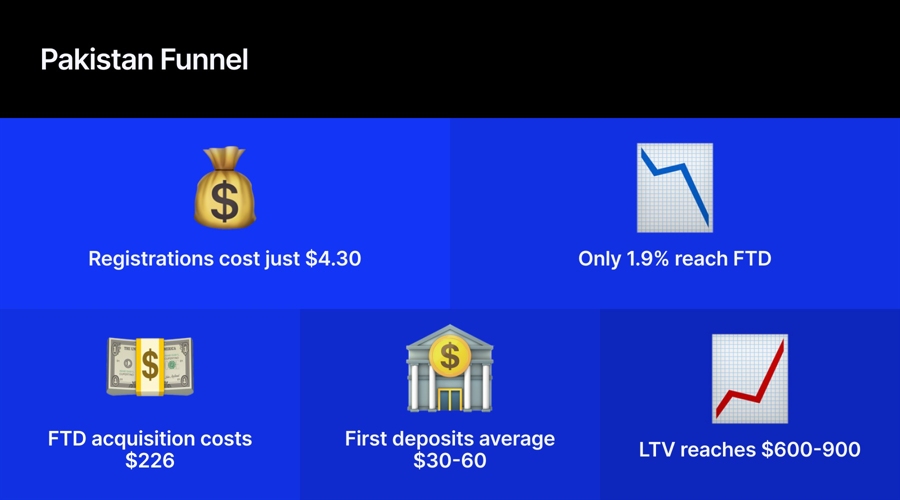
Registrations out of
Pakistan come in at $4.30, among the cheapest leads in any market we buy in. We did not earn that price through
media buying. It is what happens when most of the industry reads two policy pages, concludes the market is shut, and never tests the assumption.
Those leads convert
to first deposits at 1.9%, putting a first-time depositor at $226 against an average first deposit of $30 to $60. Every explanation an acquisition team reaches for first turns out to be wrong
here: creative fatigue, targeting, page speed, and offer strength. Fix all four, and
the number barely moves.
The leads die on the
deposit page.
These figures come
from FinforceOne campaign data and our
clients’ portfolio data, with media bought across Google, Meta, Taboola,
Outbrain, RichAds and Moloco. Nothing comparable is published: no
Pakistan-specific CPA or revenue-share benchmark exists in the public record,
only vendor ceilings advertised as maxima.
A first
deposit covering a fifth of acquisition cost means
the market only clears on redeposits, so a campaign judged before month six
will show a loss and be right to. The 1.9% has a simpler explanation than
audience quality.
We
learned this the expensive way. On our first Pakistan
campaign, the leads arrived at $4.30 and converted at 1.3%, which put a
first-time depositor at $331. For three weeks, we blamed traffic quality and cut
partners.
Then we sat through the session recordings and watched what was
actually happening: people reached the deposit page, saw card options their
bank would decline and a wallet route they had never used, and left. So we
stopped treating funding as a checkout step and
rebuilt it as content.
|
Metric |
Value |
How to read it |
|
CPL, registration |
$4.30 |
Cheap, because most |
|
Lead to FTD |
1.9% |
Below the normal band: |
|
Cost per FTD |
$226 |
Expensive relative to |
|
Average first deposit |
$30-60 |
Covers 20% of |
|
LTV, 12 months |
$600-900 |
Earned through many |
|
LTV to cost per FTD |
3.3x |
Viable, with no margin |
|
Payback |
6-9 months |
Fund it as a two-quarter |
|
Minimum monthly test |
$10,000-20,000 |
Roughly 45-90 FTDs a |
A walkthrough in Urdu of the two routes that actually work, a named local agent on WhatsApp attached to each, and a rule that anyone reaching the deposit page without completing hears from that agent within fifteen minutes. Same traffic, same CPL, same creative.
Conversion went to 1.9%,
and cost per FTD fell to $226, a 32% reduction from a change no creative test
would have found. The
agents had been telling us the same thing in different
words for weeks before we listened. Their clients do not ask about spreads or
leverage . They ask whether the money comes back out, and how long it takes.
Read more: MENA Expansion Isn’t a Market Entry Problem. It’s a Localisation Problem.
The Document
Behind the Deposit Page
That step
exists because of a document most entry memos
never open. On 18 May 2022, the State Bank issued Exchange Policy Department
Circular Letter No. 08 of 2022 to all authorised dealers, titled
“Operations of Illegal Offshore Foreign Exchange Trading, Margin Trading,
Contract for Difference (CFD) Trading Websites/ Apps/ Platforms – Outflow of
Foreign Exchange”.
It names examples. Three
provisions matter. Residents buying these products
from offshore platforms are stated to be in violation of section 4(1) of the
Foreign Exchange Regulation Act 1947. Remittance to them through any payment
channel, directly or indirectly, is not allowed under section 5(1).
And
authorised dealers must monitor, identify and block such platforms from taking
payments through any channel. It targets named platforms rather than a merchant
category, and addresses buying and paying rather than registering an unfunded
account.
The Pages
Everyone Does Read
Which is
not where the industry looks. Google’s Complex
Speculative Financial Products policy lists the locations where CFDs, rolling
spot forex and spread betting may be advertised, each tied to a national
regulator the advertiser must be licensed by. Pakistan is not among them, and
there is no self-serve certification route, because certification is granted
per approved location.
Meta gets
misread more often. Contract for difference sits
on Meta’s prohibited list, which is why broker campaigns describe the product
line as derivatives or forex. That is ordinary practice under Meta’s own
taxonomy, which files forex platforms, derivatives and options services under
restricted.
Restricted requires country-specific authorisation mapped to a
national regulator, and mandatory advertiser verification expanded to 38
markets during 2026. Pakistan licenses neither retail forex nor CFDs, so there
is no local credential to submit.
Read
together, those pages say the market is shut. They
describe the default path, and the default path is not the only one. On Meta,
where no standardised regulator mapping exists, the policy team handles
authorisation case by case. On Google, the location list governs the
speculative product itself, so what matters is which entity advertises and what
it is actually promoting.
Neither route is read off a help page, and both turn
on a broker’s licensing structure. Entrants who never test the assumption are
why a Pakistani registration still costs $4.30.
This
puts the two obstacles in the wrong
order in most entry memos. The ad account is an engineering problem with a
known route through it. No advertising structure changes what a Pakistani bank
is instructed to do with the payment.
|
Layer |
Status |
Instrument |
|
Advertising the product |
Closed by default |
Google: Pakistan not on |
|
The trade itself |
Restricted for residents |
FERA 1947 s.4(1), as |
|
Funding the account |
Not permitted via any |
FERA 1947 s.5(1); |
|
The workaround rail |
Legal, contested, newly |
USDT via P2P. Virtual |
|
Enforcement against |
Not observed |
FIA activity targets |
The legal position of a Pakistan entry,
layer by layer, August 2026.
Why the Market Exists Anyway
The bottom row of that table explains the rest
of it. In February 2026, the Interior Ministry told the National Assembly that
since January 2025, there had been 551 raids, 703 arrests and 324 cases ending
in conviction, all against illegal currency operators and hawala-hundi dealers.
Nowhere in that record is a retail trader prosecuted for holding an offshore
account.
The demand is not in doubt, and the sharpest
evidence sits with the regulated venue. Pakistan Mercantile Exchange turned
over PKR 9.77 trillion in FY2025-26 on a cumulative account base of 67,585,
confirmable as cumulative because the chief executive put total accounts opened
at 64,000 in a March 2026 interview.
Nineteen years of lawful, locally
protected access has produced fewer than seventy thousand accounts in a country
of 252 million. PMEX had the product all along.
The Rail Carries Three Loads
Deposits, therefore, arrive through stablecoins
and local agents who absorb the rupee leg. USDT does the work card processing
does elsewhere, and 2026 added two weights to it.
• Foreign exchange law. Buying USDT locally and sending it to
an offshore broker is not a documented exception. The circular covers indirect
remittance through any payment channel, and no SBP or PVARA guidance says
otherwise. That is an inference from the instrument rather than a decided case.
• Virtual asset regulation. The Virtual Assets Act 2026 made
PVARA a permanent federal regulator, with licensing regulations notified on 21
August 2026. Unlicensed operation carries fines to PKR 50 million and five
years; unauthorised offering or promotion of virtual asset services a separate
penalty to PKR 25 million and three years. That promotion clause and
funding-education content point at each other.
• Religious opinion. On 10 June 2026, the Darul Ifta of Jamia
Darul Uloom Karachi ruled, over the signature of Mufti Muhammad Taqi Usmani and
five other scholars, that cryptocurrency does not constitute wealth under
Islamic law. Circulated reproductions extend that to stablecoins, including
USDT, though the wording rests on secondary reproduction. PVARA’s chairman has
since asked the seminary to distinguish speculative from asset-backed tokens,
and an analyst quoted by Reuters in July said volumes appeared unaffected.
Together, they make the deposit rail part of
a Pakistan entry that needs legal sign-off and monitoring.
What This Changes
An acquisition team that audits only ad policy
will think the compliance work is done. Three items say otherwise:
• Take a documented legal position on the client
relationship, informed by the State Bank’s stated view of resident-side
funding, before the first dollar of traffic. This one belongs to the board.
• Get counsel to review funding-education content
specifically. Not the risk warning, not the terms page. The material that
explains how to move money.
• Report Pakistan on its own line. At $226 a trader against a
$45 first deposit, a blended regional CAC shows a comfortable average and hides
a nine-month payback nobody budgeted for.
Pakistan filters entrants hard, and not on
budget. It filters on patience, on appetite for building a funding rail by
hand, and on how a compliance function answers the question above. That is why
the operators who did the work there are not fighting anyone for the audience.
The barrier was never the ad account. It is everything an ad account hides.
Registrations out of
Pakistan come in at $4.30, among the cheapest leads in any market we buy in. We did not earn that price through
media buying. It is what happens when most of the industry reads two policy pages, concludes the market is shut, and never tests the assumption.
Those leads convert
to first deposits at 1.9%, putting a first-time depositor at $226 against an average first deposit of $30 to $60. Every explanation an acquisition team reaches for first turns out to be wrong
here: creative fatigue, targeting, page speed, and offer strength. Fix all four, and
the number barely moves.
The leads die on the
deposit page.
These figures come
from FinforceOne campaign data and our
clients’ portfolio data, with media bought across Google, Meta, Taboola,
Outbrain, RichAds and Moloco. Nothing comparable is published: no
Pakistan-specific CPA or revenue-share benchmark exists in the public record,
only vendor ceilings advertised as maxima.
A first
deposit covering a fifth of acquisition cost means
the market only clears on redeposits, so a campaign judged before month six
will show a loss and be right to. The 1.9% has a simpler explanation than
audience quality.
We
learned this the expensive way. On our first Pakistan
campaign, the leads arrived at $4.30 and converted at 1.3%, which put a
first-time depositor at $331. For three weeks, we blamed traffic quality and cut
partners.
Then we sat through the session recordings and watched what was
actually happening: people reached the deposit page, saw card options their
bank would decline and a wallet route they had never used, and left. So we
stopped treating funding as a checkout step and
rebuilt it as content.
|
Metric |
Value |
How to read it |
|
CPL, registration |
$4.30 |
Cheap, because most |
|
Lead to FTD |
1.9% |
Below the normal band: |
|
Cost per FTD |
$226 |
Expensive relative to |
|
Average first deposit |
$30-60 |
Covers 20% of |
|
LTV, 12 months |
$600-900 |
Earned through many |
|
LTV to cost per FTD |
3.3x |
Viable, with no margin |
|
Payback |
6-9 months |
Fund it as a two-quarter |
|
Minimum monthly test |
$10,000-20,000 |
Roughly 45-90 FTDs a |
A walkthrough in Urdu of the two routes that actually work, a named local agent on WhatsApp attached to each, and a rule that anyone reaching the deposit page without completing hears from that agent within fifteen minutes. Same traffic, same CPL, same creative.
Conversion went to 1.9%,
and cost per FTD fell to $226, a 32% reduction from a change no creative test
would have found. The
agents had been telling us the same thing in different
words for weeks before we listened. Their clients do not ask about spreads or
leverage . They ask whether the money comes back out, and how long it takes.
Read more: MENA Expansion Isn’t a Market Entry Problem. It’s a Localisation Problem.
The Document
Behind the Deposit Page
That step
exists because of a document most entry memos
never open. On 18 May 2022, the State Bank issued Exchange Policy Department
Circular Letter No. 08 of 2022 to all authorised dealers, titled
“Operations of Illegal Offshore Foreign Exchange Trading, Margin Trading,
Contract for Difference (CFD) Trading Websites/ Apps/ Platforms – Outflow of
Foreign Exchange”.
It names examples. Three
provisions matter. Residents buying these products
from offshore platforms are stated to be in violation of section 4(1) of the
Foreign Exchange Regulation Act 1947. Remittance to them through any payment
channel, directly or indirectly, is not allowed under section 5(1).
And
authorised dealers must monitor, identify and block such platforms from taking
payments through any channel. It targets named platforms rather than a merchant
category, and addresses buying and paying rather than registering an unfunded
account.
The Pages
Everyone Does Read
Which is
not where the industry looks. Google’s Complex
Speculative Financial Products policy lists the locations where CFDs, rolling
spot forex and spread betting may be advertised, each tied to a national
regulator the advertiser must be licensed by. Pakistan is not among them, and
there is no self-serve certification route, because certification is granted
per approved location.
Meta gets
misread more often. Contract for difference sits
on Meta’s prohibited list, which is why broker campaigns describe the product
line as derivatives or forex. That is ordinary practice under Meta’s own
taxonomy, which files forex platforms, derivatives and options services under
restricted.
Restricted requires country-specific authorisation mapped to a
national regulator, and mandatory advertiser verification expanded to 38
markets during 2026. Pakistan licenses neither retail forex nor CFDs, so there
is no local credential to submit.
Read
together, those pages say the market is shut. They
describe the default path, and the default path is not the only one. On Meta,
where no standardised regulator mapping exists, the policy team handles
authorisation case by case. On Google, the location list governs the
speculative product itself, so what matters is which entity advertises and what
it is actually promoting.
Neither route is read off a help page, and both turn
on a broker’s licensing structure. Entrants who never test the assumption are
why a Pakistani registration still costs $4.30.
This
puts the two obstacles in the wrong
order in most entry memos. The ad account is an engineering problem with a
known route through it. No advertising structure changes what a Pakistani bank
is instructed to do with the payment.
|
Layer |
Status |
Instrument |
|
Advertising the product |
Closed by default |
Google: Pakistan not on |
|
The trade itself |
Restricted for residents |
FERA 1947 s.4(1), as |
|
Funding the account |
Not permitted via any |
FERA 1947 s.5(1); |
|
The workaround rail |
Legal, contested, newly |
USDT via P2P. Virtual |
|
Enforcement against |
Not observed |
FIA activity targets |
The legal position of a Pakistan entry,
layer by layer, August 2026.
Why the Market Exists Anyway
The bottom row of that table explains the rest
of it. In February 2026, the Interior Ministry told the National Assembly that
since January 2025, there had been 551 raids, 703 arrests and 324 cases ending
in conviction, all against illegal currency operators and hawala-hundi dealers.
Nowhere in that record is a retail trader prosecuted for holding an offshore
account.
The demand is not in doubt, and the sharpest
evidence sits with the regulated venue. Pakistan Mercantile Exchange turned
over PKR 9.77 trillion in FY2025-26 on a cumulative account base of 67,585,
confirmable as cumulative because the chief executive put total accounts opened
at 64,000 in a March 2026 interview.
Nineteen years of lawful, locally
protected access has produced fewer than seventy thousand accounts in a country
of 252 million. PMEX had the product all along.
The Rail Carries Three Loads
Deposits, therefore, arrive through stablecoins
and local agents who absorb the rupee leg. USDT does the work card processing
does elsewhere, and 2026 added two weights to it.
• Foreign exchange law. Buying USDT locally and sending it to
an offshore broker is not a documented exception. The circular covers indirect
remittance through any payment channel, and no SBP or PVARA guidance says
otherwise. That is an inference from the instrument rather than a decided case.
• Virtual asset regulation. The Virtual Assets Act 2026 made
PVARA a permanent federal regulator, with licensing regulations notified on 21
August 2026. Unlicensed operation carries fines to PKR 50 million and five
years; unauthorised offering or promotion of virtual asset services a separate
penalty to PKR 25 million and three years. That promotion clause and
funding-education content point at each other.
• Religious opinion. On 10 June 2026, the Darul Ifta of Jamia
Darul Uloom Karachi ruled, over the signature of Mufti Muhammad Taqi Usmani and
five other scholars, that cryptocurrency does not constitute wealth under
Islamic law. Circulated reproductions extend that to stablecoins, including
USDT, though the wording rests on secondary reproduction. PVARA’s chairman has
since asked the seminary to distinguish speculative from asset-backed tokens,
and an analyst quoted by Reuters in July said volumes appeared unaffected.
Together, they make the deposit rail part of
a Pakistan entry that needs legal sign-off and monitoring.
What This Changes
An acquisition team that audits only ad policy
will think the compliance work is done. Three items say otherwise:
• Take a documented legal position on the client
relationship, informed by the State Bank’s stated view of resident-side
funding, before the first dollar of traffic. This one belongs to the board.
• Get counsel to review funding-education content
specifically. Not the risk warning, not the terms page. The material that
explains how to move money.
• Report Pakistan on its own line. At $226 a trader against a
$45 first deposit, a blended regional CAC shows a comfortable average and hides
a nine-month payback nobody budgeted for.
Pakistan filters entrants hard, and not on
budget. It filters on patience, on appetite for building a funding rail by
hand, and on how a compliance function answers the question above. That is why
the operators who did the work there are not fighting anyone for the audience.
The barrier was never the ad account. It is everything an ad account hides.


