

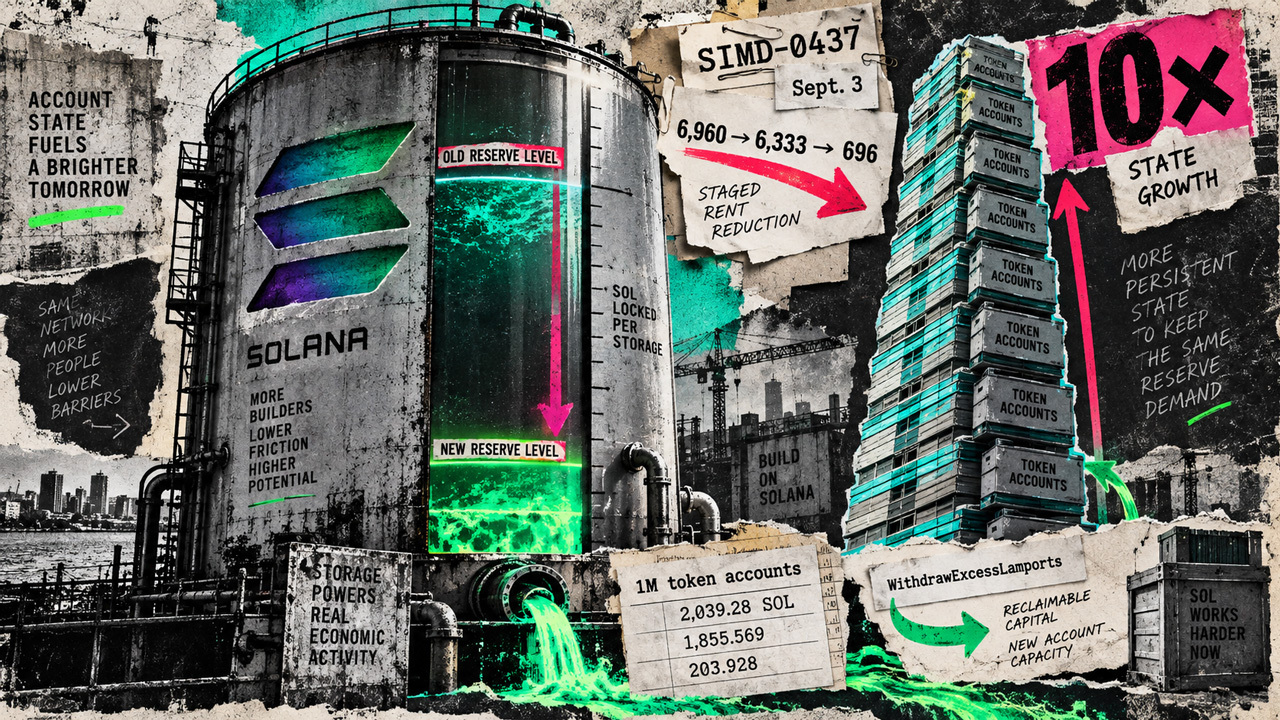
Eligible Solana token-account owners can reclaim excess SOL previously needed to keep their token accounts open after the network’s first rent reduction went live Sept. 3. For businesses funding new accounts, the same change lowers the upfront capital required to create them.
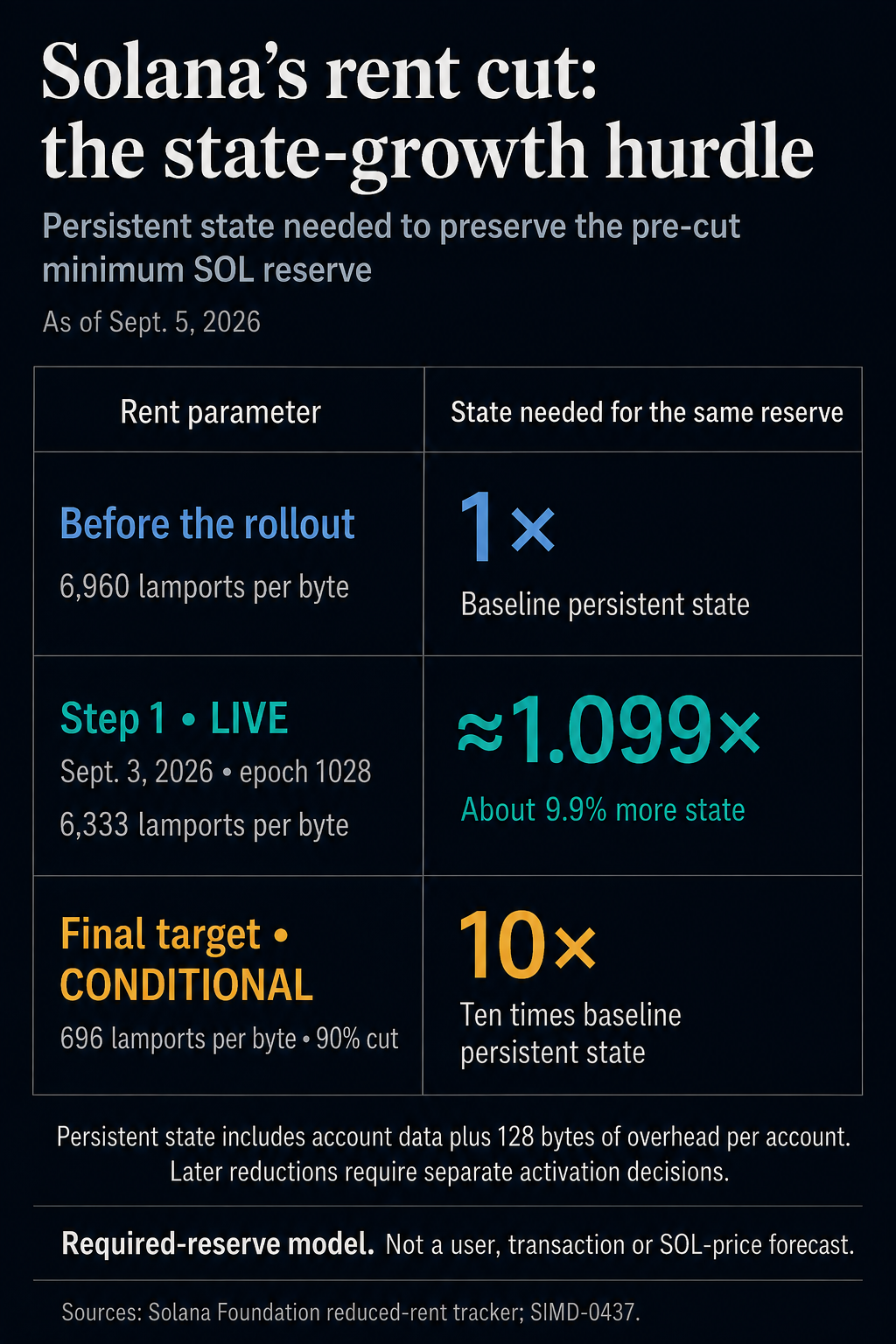
The full plan would change how account growth translates into SOL held against storage. If Solana completes its proposed 90% reduction, total persistent account state, including each account’s storage overhead, would have to grow tenfold to require the same minimum SOL reserves as before the rollout. Adoption could expand substantially while the minimum SOL needed for this reserve channel falls.
The Solana Foundation’s tracker confirms that only the first reduction, approximately 9%, is live on mainnet. The tenfold comparison applies to the conditional final target, while the initial cut already lowers reserve requirements.
Solana rent reduction and the 10× hurdle
Solana’s “rent” is a balance held against account storage. It is generally recoverable when an account closes, rather than an ongoing bill paid to validators. Reducing the required balance lets new accounts begin with less SOL and can leave existing accounts holding more than their minimum.
At epoch 1028 on Sept. 3, Solana lowered the reserve parameter from 6,960 to 6,333 lamports per byte. The five-stage plan’s final target is 696.
Under SIMD-0437, the rent-reduction specification, that minimum equals the account’s data size plus 128 bytes of overhead, multiplied by the current lamports-per-byte parameter. A standard token account has 165 data bytes, making its effective size 293 bytes.
Applying that formula to one million identical standard token accounts gives the following illustration:
| Scenario | Lamports per byte | Required reserve | Reduction versus original |
|---|---|---|---|
| Before the rollout | 6,960 | 2,039.28 SOL | Baseline |
| First step, live Sept. 3 | 6,333 | 1,855.569 SOL | 183.711 SOL |
| Final target, conditional | 696 | 203.928 SOL | 1,835.352 SOL |
These are calculated minimum requirements for a fixed account population, not measured withdrawals. The final row assumes all five reductions activate. Different account sizes would produce different totals.
The million-account example illustrates operating capital, but it cannot establish a network-wide supply effect. Its conditional final reduction of 1,835.352 SOL represents about 0.000314% of the approximately 585.36 million circulating SOL shown in CryptoSlate’s Sept. 5 market data. The actual aggregate reserve channel requires a broader account inventory, with account sizes, balances and reclaimability taken into account.
The tenfold threshold follows from the same relationship. At one-tenth the original reserve rate, ten times as many rent-bearing bytes would be needed to keep the aggregate minimum unchanged. It measures the total stock of persistent state, including per-account overhead. User counts, transaction counts and SOL prices are separate measures; the tenfold comparison describes storage requirements.
The live first step sets a smaller hurdle: about 9.9% more rent-bearing state would preserve the original minimum requirement at 6,333 lamports per byte. Both comparisons concern required reserves. Actual account balances can remain above those floors.
For payments, this reserve demand arises mainly when accounts are opened. The Foundation’s July account-state study explains that an associated token account normally serves a particular wallet and token mint. Once it exists, later payments in the same token do not require another account-creation deposit. More payments through existing accounts therefore need not produce a proportional increase in storage reserves.
Withdrawal authority decides who gets the capital
The immediate benefit is access to capital already on-chain. The Foundation’s Sept. 3 reclamation guide describes an instruction called WithdrawExcessLamports that moves SOL above the current minimum without closing a token account or changing its token balance. The Token-2022 program offers the same instruction.
For a token account, its owner must authorize the withdrawal. For a mint, authorization comes from the mint authority, or from the mint account itself signing if that authority has been revoked. Accounts owned by custom programs need the owning program to provide withdrawal logic and check the relevant authority.
That makes control of the account economically significant. A payments provider that funded a customer’s token account cannot assume that paying the original deposit gives it the right to reclaim the excess. The party entitled to authorize the withdrawal may be different from the party that supplied the SOL.
Moving a surplus balance requires an authorized transaction that leaves the minimum intact. It transfers existing SOL between accounts while conserving the total; it does not issue new tokens. The guide provides no aggregate measure of completed withdrawals or subsequent sales.
For future onboarding, the benefit is more direct: whoever funds an account needs less SOL upfront. Providers can potentially support more customer accounts with the same capital, even when customers themselves do not purchase SOL. Whether existing surplus can be redeployed depends on the authority and program arrangements above.
How long those accounts survive will determine the continuing reserve requirement. Gross account creation can give a very different impression from state that remains on-chain.
In his July 20 analysis, Solana Foundation researcher Umberto Natale found that 75.5% of account-creation events in the analyzed cohort closed within the same transaction. The observations were not deduplicated by address: repeated creation and closure could count as separate events.
Those workflows can generate activity while leaving little persistent account storage behind. The finding does not predict how users will respond to September’s reduction. The study also cautions that its weak, unstable correlations between SOL prices and account activity are descriptive, rather than a causal estimate of how cheaper rent changes demand.
A useful test of the policy will therefore track persistent account bytes and their associated minimum reserves alongside activity. Counting new accounts alone cannot establish whether the network has absorbed the lower reserve rate.
SOL demand extends beyond account reserves
Other uses of SOL also continue. Under Solana’s fee rules, transactions require SOL: half the base fee is burned and half goes to the validator, while the entire priority fee goes to the validator. Fee payments are a separate demand channel from refundable account reserves. More activity could increase fee use, but throughput alone does not establish the amount users pay or the balances they retain.
SOL holders can also delegate stake to validators to help secure the network and become eligible for rewards. Reclaimed capital could be staked or used to fund more accounts. The cited material does not establish either outcome as a result of the cut, so these possibilities provide no quantified offset to lower reserve requirements.
CryptoSlate’s recent analysis of activity and fee economics examined a related distinction: network usage and token economics can move differently. Rent reduction adds a specific reason why growth can require less SOL per unit of persistent state.
As of Sept. 5, the second reduction, to 5,080 lamports per byte, is on testnet, with mainnet expected in mid-September. The last three steps are expected with Agave 4.4 in November. Each activation remains subject to review of state growth, and a fallback can restore the original parameter.
The next gates will determine how far the capital saving goes. Persistent state growth and actual reclamation will then show how much of that saving becomes new account capacity, reusable working capital or reduced SOL held against storage.


